Understand what good AI adoption looks like.
Managers learn how to recognise suitable use cases, assess trade-offs, understand privacy and governance, and distinguish a useful workflow from an impressive demo.
Leadica helps established businesses identify where time, capacity, cost or customer experience can be improved, then turns the strongest opportunities into a practical roadmap. Training and coaching build internal capability. Implementation can be separately scoped where it adds value.
Efficiency · Process & systems · AI & automation · Training & coaching · Reporting · Scalability
We do not begin with a list of AI tools. We begin by understanding how the business actually works – where time is being lost, where information gets stuck, where customers wait, where managers lack visibility and where extra capacity would create the greatest value.
Sometimes the answer is AI. Sometimes it is automation, process redesign, integration or better use of existing software. The objective is business optimisation, supported by technology where it genuinely improves the work.
AI is the tool. Automation is the tool. Optimisation is the outcome.
Understand the business objectives, operating friction, people, processes, systems, data and current capability.
Build management understanding, identify practical AI and automation opportunities, and rank them by value, feasibility, risk and readiness.
Define the future process, expected benefit, responsibilities, measures and the next actions. Coach managers so they can make better technology decisions themselves.
Where separately scoped, configure tools, automation and integrations, train users, document the workflow and put it into normal operations.
Review what changed: time or capacity released, process consistency, customer response, management visibility, cost or revenue impact.
Managers learn how to recognise suitable use cases, assess trade-offs, understand privacy and governance, and distinguish a useful workflow from an impressive demo.
We work through real workflows, systems, information and customer journeys so the learning becomes a set of practical decisions rather than workshop notes.
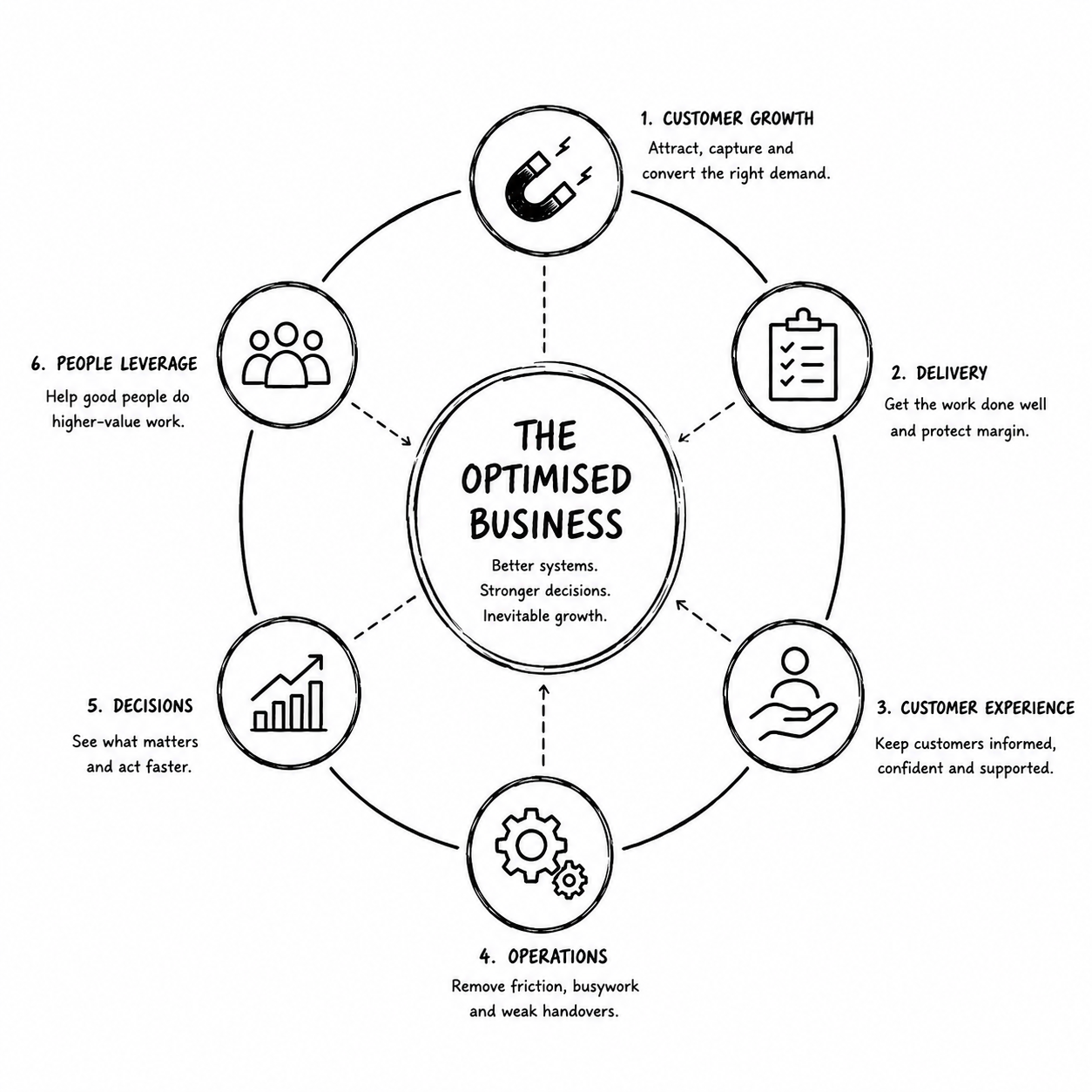
Leadica’s six-pillar framework keeps advisory work connected to customers, delivery, operations, management decisions and people. It prevents an AI project from becoming a disconnected technology exercise.
Leadica reviewed how enquiries, quoting, follow-up and job information moved through the business, then worked with the team to identify where manual admin, hand-offs and founder dependency were limiting capacity.
The engagement combined process mapping, practical training and targeted automation around the existing operating environment.
Focus: clearer workflows, less avoidable administration and a more scalable operating model.
Leadica mapped a complex lead-handling process involving response times, follow-up, callbacks, communication, CRM stages, adviser availability and management visibility before any system was built.
That operating model was then translated into a purpose-built workflow that gives the team clearer ownership, next actions and a more consistent way to move enquiries through to adviser meetings.
Focus: more consistent lead handling, clearer accountability and a stronger foundation for reporting and ongoing optimisation.
Public examples are deliberately anonymised and high level. We do not publish a client’s operating playbook, commercially sensitive workflow or implementation detail without permission. More detailed evidence can be shared privately where appropriate.
A selection of businesses Leadica has worked with across its commercial services.












Leadica starts with the business rather than a particular AI product. We assess processes, systems, information flows and management priorities, identify where AI or automation could create practical value, prioritise the opportunities and turn the strongest ones into a roadmap.
No. Training is tied to real business workflows and decisions. AI may be part of the answer, but process redesign, automation, integration or better use of existing systems may be more appropriate.
Yes. Where implementation is justified, Leadica can separately scope automation, AI, CRM, integrations, reporting, workflow changes or bespoke business systems. Advisory and training do not create an obligation to use Leadica for implementation.
We look at business value, time or capacity released, feasibility, data readiness, cost, risk, adoption and speed to value. The aim is to prioritise practical improvements rather than create a long list of AI ideas.
It is designed for established New Zealand businesses where owners and senior managers want to improve efficiency, systems, customer experience, management visibility or scalability and need a practical way to decide where AI and automation fit.
Bring us one process that is slow, repetitive, unclear or difficult to scale. We’ll help determine whether the answer is process improvement, automation, AI, integration or a better use of the systems you already have.